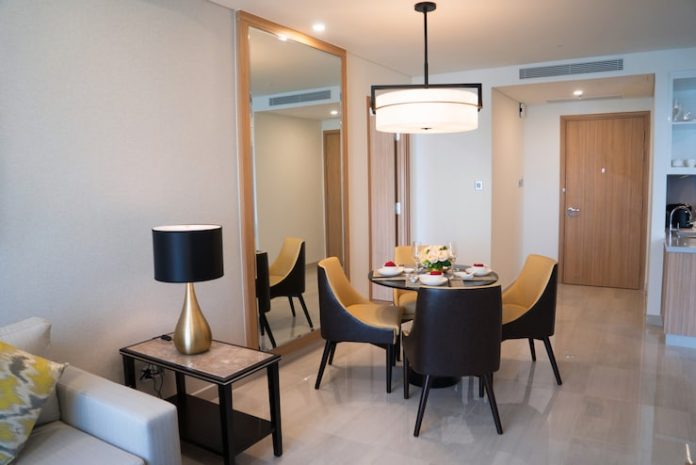

A studio apartment is one of the most challenging decorating environments — and one of the most rewarding when done right. You’re working with a single room that needs to function as a bedroom, living room, dining area, workspace, and sometimes a kitchen extension. The margin for error is slim, but the potential for a beautiful, efficient small space is real.
Here’s what actually works in studio apartments — based on the principles that make small spaces feel large.
Layout First: Everything Else Follows
The most important decision in a studio apartment is where to place things — and specifically, how to create the illusion of separate zones without walls. The way you divide your studio visually will determine whether it feels like a thoughtfully designed home or a chaotic single room.
Use Furniture to Define Zones
A sofa placed with its back to the sleeping area creates an implied boundary between the living zone and the bedroom without blocking light or adding bulk. A bookshelf used as a partial divider, an area rug that grounds the living furniture, a curtain track ceiling-mounted above the bed — these are all ways to carve out distinct zones in open space.
Avoid Pushing All Furniture Against Walls
This is the most common studio apartment mistake. When every piece of furniture is against a wall, the center of the room becomes dead, awkward space. Pull your sofa and chairs in slightly, creating a defined seating cluster. The room instantly feels more purposeful and, counterintuitively, more spacious.
Furniture: What to Choose and What to Avoid
Studio apartment furniture needs to be multifunctional, appropriately scaled, and visually light. Every piece should earn its footprint.
- Murphy beds or loft beds: Reclaim the floor space your bed occupies during the day — the single most impactful change in a studio
- Sofa beds: A quality sofa bed (not a cheap futon) gives you a true living space during the day
- Nesting tables: Stack away when not needed; spread out when entertaining
- Storage ottomans: Serve as seating, coffee table, and hidden storage simultaneously
- Dining chairs that tuck fully under the table: Reclaim floor space when the table is not in use
- Furniture with legs: Pieces raised off the floor let you see under them, making the room feel larger
Maximizing Storage in a Studio Apartment
Storage is where studio apartment living either works or breaks down. You need to be creative, vertical, and consistent.
- Floor-to-ceiling shelving: Use the full wall height — the space above eye level is almost always wasted in small apartments
- Under-bed storage: Invest in a bed frame with built-in drawers or use shallow rolling bins
- Behind-door organizers: The back of every closet and bathroom door is usable storage space
- Vertical kitchen storage: Magnetic knife strips, wall-mounted spice racks, pot racks — keep counters clear
- Built-in window seats: If your building allows modifications, a built-in bench with lift-top storage under a window is one of the best studio investments
Pro Tip: Declutter before you organize. Storage solutions in a studio apartment only work if you first reduce what you own to what you actually need and use. Every item in a small space costs visual real estate.
Light: Make Every Lumen Count
Light is the studio apartment’s best friend — or worst enemy, depending on how you handle it. More light makes a small space feel larger, more airy, and more pleasant to spend time in.
- Keep window treatments light and sheer where privacy allows
- Place mirrors on walls that face or adjoin windows to bounce light further into the room
- Layer lighting: overhead, floor lamps, task lamps — never rely on a single overhead fixture
- Use warm-toned bulbs (2700K–3000K) to make the space feel cozy rather than institutional
Color Strategy for Studio Apartments
A consistent color palette makes a studio apartment feel unified rather than fragmented. Choose two main colors and one accent, and use them throughout the entire space — this visual continuity makes the eye read the space as larger and more intentional.
Lighter tones on walls and large furniture make rooms feel more open. Reserve deeper, bolder colors for accents — cushions, a throw, a piece of art. One exception: painting the ceiling the same color as the walls (rather than leaving it white) can make a studio feel like a cocooning refuge rather than a box.
The Studio Apartment Mindset
A studio apartment well-designed is one of the most comfortable and satisfying ways to live. Everything is within reach. Cleaning takes thirty minutes. And the discipline of small-space living tends to produce a more curated, intentional home than a larger space ever would.
The goal isn’t to make your studio apartment look bigger than it is — it’s to make it feel exactly as big as you need it to be.